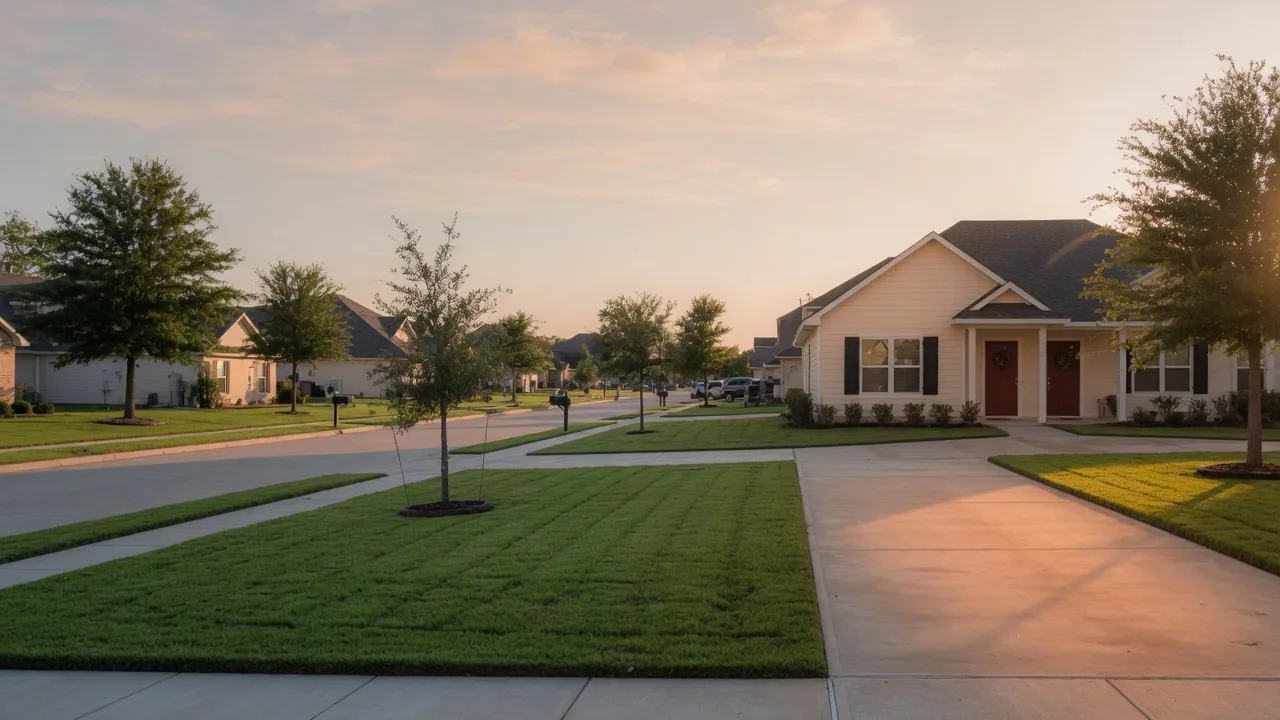
Illustrative image.
Can Katy, Texas be a good place to buy a rental property in 2026? Yes, for the right address, with the math checked first: Katy's rental demand is structurally strong, while both prices and rents have cooled over the past year, so this is a market where the deal has to work on paper before it will work in practice. This guide gives you the sourced 2026 numbers for sale prices and rents, works the yield arithmetic on a typical three-bedroom, and lists the checks that separate a solid Katy rental from a quiet money pit. Nothing here is a promise of return; every figure has a source and a date.
Why Katy rents, and why the geography matters first
Katy rents because three forces pull tenants in at once. The Energy Corridor, the employment district about 13 miles east along I-10, reported roughly 64,656 jobs with an average salary of $86,100 and about $25.2 billion in annual economic output in the district's 2025 economic snapshot (Energy Corridor District). Workers who want a yard and good schools but do not want to buy yet are the classic Energy Corridor renter. Katy ISD, which welcomed more than 97,000 students for the 2025-26 school year and has ranked No. 1 among Houston-area school districts in Niche's annual ratings for four consecutive years, keeps family rental demand high in its attendance zones. And the headcount keeps growing: Fort Bend County, home to the south side of greater Katy, stood at 958,434 residents in the 2024 Census estimate, up about 3.4 percent in a single year, and areawide estimates put the greater Katy population itself near 340,000.
One geography note before any number: "Katy" is three different geographies, and rental math follows the address, not the name. The City of Katy is a small incorporated city centered on Old Town. Greater Katy is the sprawling unincorporated area that carries Katy mailing addresses, split between Harris County north of I-10 and Fort Bend County south of it. Katy ISD is the school district that reaches across parts of all three counties. A house can be zoned to Katy ISD schools, carry a Katy address, and sit in either county, with different taxes, flood maps and market norms. The moving to Katy guide lays out that geography in detail; rental buyers should read it first.
What a Katy rental home sells for in 2026
The Houston Association of Realtors' official Katy price trends page puts the median single-family sale price at $334,900 in September 2026 (on 443 sales, with an average sale price of $408,485), after $350,000 in July and $349,990 in August (HAR.com Katy price trends). Zillow's average home value for Katy came in at $330,372 as of September 30, 2026, down 3.2 percent year over year (Zillow market data). Note the difference in methods: HAR reports closed sale medians, while Zillow's figure is an estimated average value, and the two should not be treated as the same number.
What the trend says: home prices in Katy have stepped back from their peak rather than rising, which changes the investor's entry math. A buyer negotiating in this market has real leverage on price, condition and closing dates that did not exist a few years ago. The market data page tracks these same figures month by month, and the 2026 market update post explains the trend with full sources.
What that home rents for in 2026
Rental listings tell a layered story. Zillow's Rental Manager tracker put Katy's median rent across all property types near $2,319 a month, while RentEst's June 2026 report put the average three-bedroom single-family home near $2,109 a month and four-bedrooms near $2,704 (Zillow Rental Manager market trends). Active three-bedroom listings in the 77494 and 77449 areas cluster between roughly $2,100 and $2,400 a month, with four- and five-bedroom homes in the $2,700 to $4,000 band and newer master-planned communities like Elyson and Cross Creek Ranch asking $2,900 to $3,150 for family-sized homes.
The honest counterweight: 2026 has been a cooler rental year. A SmartAsset analysis of rental data that CultureMap Houston reported in February 2026 ranked Katy among the biggest rent declines nationally, with typical rent at $1,896 in February 2026, down 1.43 percent from $1,923 a year earlier, though still up about 22 percent from 2021 (CultureMap Houston / SmartAsset). More rental inventory and cooler demand mean landlords must price to the market, and investors should underwrite rent at today's realistic level, not at yesterday's peak.
The deal math on a typical 3-bedroom
Put the two dated figures together for a simple illustrative check. Buy near the September 2026 HAR median of about $335,000, and rent at a realistic current $2,300 a month. Annual gross rent is about $27,600, which is roughly 8.2 percent of the purchase price before any costs. That gross number is the ceiling, not the return.
From the 8.2 percent gross figure, a Katy landlord pays vacancy (budget a month or two a year between tenants, 5 to 8 percent), property taxes and MUD fees, homeowners insurance plus flood insurance where required, HOA dues in most master-planned communities, a property manager at roughly 8 to 10 percent of collected rent if you use one, plus maintenance and capital reserves. Subtract those and the net cash yield on an all-cash deal typically lands a few points lower; on a financed purchase, mortgage costs come out of the remainder. This is elementary arithmetic from the two sourced figures above, not a promise of any specific return. It is why the cheapest-looking Katy rental can be the worst investment: a $30,000 lower price usually comes with older systems, a smaller rent, or both.
The costs that quietly shrink a Katy yield
Four Katy-specific costs deserve their own line in your spreadsheet.
Property taxes and MUDs. A Katy tax bill is a stack of rates: Katy ISD, a county (Harris or Fort Bend), sometimes the City of Katy, and in most newer master-planned communities a municipal utility district that finances the water, sewer and drainage infrastructure. A rental property is not a residence homestead, so it gets none of the homeowner protections in the taxes and MUD guide, including the school tax homestead exemption and the ten percent appraisal cap. A rental is assessed at market value, full stack, every year.
Insurance and flood exposure. Flood maps are county-specific in Katy (Harris County is working from 2007-08 era maps with new drafts pending; Fort Bend County still governs from its 2014 maps), and some Katy neighborhoods sit inside an Addicks or Barker reservoir flood pool. The flood risk guide shows the five checks to run on any address; an investor should run all five before making an offer, not after.
HOA dues. Most Katy rentals live inside a homeowners association, and dues in amenity-heavy master plans can be substantial. Ask the HOA directly whether leases are allowed, how many homes may be rented at once, and whether a minimum lease term applies. The community guides sort out which neighborhoods carry which obligations.
Management and maintenance. Out-of-area owners almost always need a local property manager, at roughly 8 to 10 percent of collected rent, and single-family maintenance in Houston heat is relentless. Undersizing either line is the most common mistake in optimistic rental projections.
Texas landlord law, in plain terms
The legal environment for Katy landlords is investor-friendly, and it is worth knowing exactly what that means. Texas prohibits local rent control: state law bars municipalities from enacting rent control ordinances, so landlords set and raise rents within what the market and the lease allow. Security deposits have no statutory maximum in Texas; the cap is whatever the lease says, and the landlord must return the deposit within 30 days of the tenant moving out, with an itemized list of any deductions, under the Texas Property Code's deposit rules. The Texas State Law Library's landlord-tenant guide is the reliable starting point for both.
On taxes, the tradeoff is the same one homeowners face: Texas has no state income tax, so the property tax bill carries the load, and a single-family rental does not qualify for the residence homestead exemption because the owner does not occupy it as a principal residence (Texas Tax Code Section 11.13). The Texas Comptroller's exemptions page spells out who qualifies and who does not.
Which Katy submarkets rent best
Rental performance varies sharply by submarket, and the dividing lines are school zones and commute distance, not ZIP code. Homes in the established neighborhoods between Old Town and the Grand Parkway rent to Energy Corridor commuters who want the shortest possible drive, and they carry smaller HOA burdens but older systems. The newer master-planned communities to the west, in the 77494 and 77407 directions, rent at the top of the market to families anchored on Katy ISD campuses, with higher dues and higher rents. The Elyson guide and the community comparison pages walk through the differences; for Cinco Ranch-specific rental detail, the dedicated Living in Cinco Ranch site keeps that depth.
One rule applies everywhere in greater Katy: school zoning is address-specific, and no single school district serves every Katy address. When a rental's demand depends on a specific school, verify the address against the district's own boundary tool before you rely on the marketing. The Katy ISD zoning guide shows exactly how to do that without guessing.
Five checks before you make an offer on a rental
- Run the address, not the ZIP. School zone, county, flood zone, MUD or city rate, all in one pass, because they all differ street by street across the Katy area.
- Underwrite today's rent, with evidence. Compare active three- and four-bedroom listings in the same community, then ask a property manager what signed leases are actually closing at, since asking rents and leased rents diverge in a cool rental market.
- Model the full tax stack on a rental basis. No homestead exemption, no ten percent cap, MUD where present. The taxes and MUD guide gives the current rates and the math.
- Read the HOA's rental rules before the contract. Lease minimums, rental caps and approval requirements belong in the feasibility analysis, not in a surprise letter after closing.
- Budget vacancy, management and reserves honestly. A deal that cash-flows with a full-year tenant, a manager and 1 percent of value set aside for repairs is a deal; a deal that only works with no vacancy and self-management is an optimistic spreadsheet.
Ask Carol: run the numbers on a Katy rental before you buy
Rental investing in Katy is address work, and it rewards local knowledge: which communities hold renters, which school zones hold demand, which MUD stacks make a cash-flow winner and which one do not. Carol Jukes, Broker/Owner of Realty Pros of Texas, works with investors as well as buyers and sellers, and she can pull current sale comps, realistic rent data, tax projections and school-zone confirmations for any property you are considering, then connect you with a local property manager who knows the area. Call her at (832) 212-2772, send a note through the contact page, and see the buying in Katy page for how the purchase process works start to finish.

Carol Jukes
Broker/Owner of Realty Pros of Texas with 35+ years in real estate, a Licensed Texas broker since 2006, and 1,500+ homes sold. Ask her anything about buying, selling or living in Katy and the Greater Houston area.
Ask Carol a question