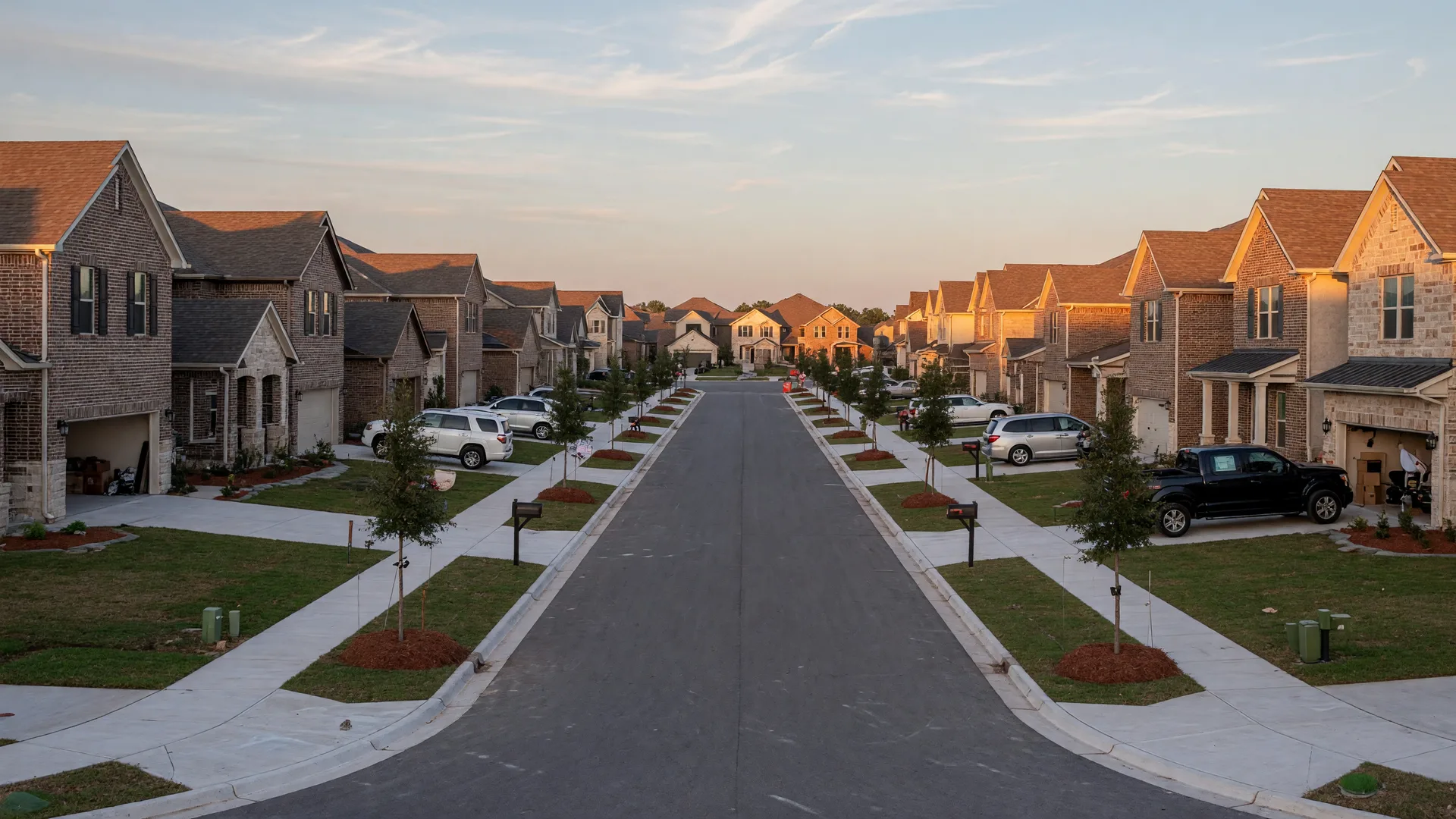
Illustrative image.
Your Katy property tax bill is not one tax. It is a stack of separate rates set by different taxing units, and the two that matter most for most buyers are Katy ISD and, in the newer master-planned communities, a municipal utility district (MUD). For the 2026-27 tax year, Katy ISD's rate is $1.1171 per $100 of assessed value, flat for the third straight year, and the state school homestead exemption is now $140,000. This guide walks through every layer of a Katy-area tax bill, what changed recently, and the two checks that protect homeowners the most: the homestead exemption and the 10 percent annual appraisal cap.
What a Katy property tax bill is actually made of
In Texas, every taxing unit that serves your home sets its own rate in dollars per $100 of assessed value, and you receive one combined bill. In the Katy area those units typically include:
- Katy ISD, the largest slice of the bill for nearly every homeowner in the area.
- The county, which depends on where the home sits: Harris County for much of northern Katy, Fort Bend County for much of the southern and southwestern side, and Waller County for a smaller share. Katy ISD itself spans parts of all three counties, roughly 181 square miles in total.
- The city, but only if the home is actually inside the City of Katy limits, which most of the big master-planned communities are not.
- MUDs and other special districts that build and run water, wastewater, drainage and sometimes parks and recreation, and that levy their own tax on top of the rest.
The most important thing to internalize is that a Katy mailing address tells you almost nothing by itself. It does not tell you the county, the city limits, or the school district for a specific home. The moving to Katy guide explains this three-way split between the City of Katy, greater Katy and Katy ISD in full, and the school zoning guide covers the address-level checks for schools.
Katy ISD: the largest slice of the bill
Katy ISD adopted a total tax rate of $1.1171 per $100 of assessed value for 2026-27 at its September 21, 2026 board meeting: $0.7271 for maintenance and operations and $0.3900 for interest and sinking, the debt service portion. It is the third consecutive year the board has held the same total rate, according to the district's own announcement and Community Impact coverage.
The rate was not always this low. Katy ISD cut it by about 18.5 cents for the 2023-24 school year, from roughly $1.30 to $1.12 per $100, driven by state property-tax compression from Senate Bill 2, and the total has been flat near $1.12 since. Over the longer run the district's rate has fallen nearly $0.40 per $100 since the 2018-19 school year. That is a real, dated trend, not a promise that future rates stay flat: the board sets a new rate every year. The official current rate lives on the Katy ISD tax rate page.
Because the school slice is the largest, the homestead exemption matters most here. For tax year 2026 the state school-district residence homestead exemption is $140,000, raised from $100,000 by Proposition 13 in November 2025 and applied retroactively to tax years beginning January 1, 2025. The exemption is taken off the assessed value before the school rate is applied, so on an illustrative $500,000 assessment, the taxable value for school purposes is $360,000 and the Katy ISD slice is about $4,022 per year, roughly $335 a month. (These example numbers are for the math only; your assessed value, exemptions and exact rates will differ.)
The City of Katy rate, and what city services buy
The City of Katy's property tax rate is $0.425 per $100 for tax year 2025, unchanged from 2024, split between maintenance and operations and debt service. Inside the city limits that rate funds the Katy Police Department, the Katy Fire Department, the city's water and wastewater systems, and trash and recycling service.
The catch for many buyers: most of the large Katy-area master plans sit outside the city limits. Elyson, for example, is in unincorporated Harris County, and Cinco Ranch is largely a Fort Bend County community, not part of the City of Katy. Homes in those communities do not pay the city rate; they pay a MUD rate instead. Whether an address is inside the city limits is a specific, checkable fact, not something a ZIP code reveals.
County rates: Harris County vs. Fort Bend County
The county slice depends entirely on where the home sits. Harris County's 2025 general fund rate is $0.38529 per $100, and once the flood control district, hospital district and Port of Houston are added, the combined county-line total is about $0.6241 per $100 for fiscal 2025-26. Fort Bend County's 2025 general fund rate is $0.412 per $100, and with the drainage district it runs about $0.422 per $100.
These are the most recent adopted rates as of this writing in October 2026; counties set new rates every year. Two community-level rules of thumb help, but only as a starting point: much of northern Katy, including Grand Lakes' original phases, sits in Harris County, while communities south and southwest of I-10, including Cinco Ranch and Cross Creek Ranch, largely sit in Fort Bend County. Verify the exact county for an address with the appraisal district before you compare two homes' tax numbers, because the county is only part of the story anyway.
MUDs: the tax that surprises new-community buyers the most
A municipal utility district is a special-purpose government that finances and operates water, wastewater, drainage and sometimes parks and recreation for a defined area, usually a new master-planned community. To repay the bonds it issues for the infrastructure, a MUD levies its own property tax on every home inside it, on top of the school and county rates.
MUD rates vary enormously. Harris County's adopted 2025 MUD rates ranged from $0.00 to $1.50 per $100, and real 2025 Katy-area examples include Fry Road MUD at $0.32825, Interstate MUD at $0.305, Fort Bend County MUD 142 at $0.597 and Fort Bend County LID 7 at $0.32274. In some Katy master-planned communities the MUD slice alone runs roughly $0.65 to $1.50 per $100. Because every layer stacks, the combined effective rate on homes in Katy-area MUD communities commonly lands around $2.90 to $3.30 per $100 of assessed value, roughly 2.9 to 3.3 percent.
The dollar impact is where it becomes real. On that same illustrative $500,000 assessment, a $0.65 MUD adds about $3,250 a year, about $271 a month. A $1.50 MUD adds about $7,500 a year, about $625 a month. That is why two homes listed at the same price can carry very different monthly costs, and it is the single most common surprise for buyers new to Katy-area new construction. The new construction vs. established homes post digs into how MUD taxes change the math on a new build, and the first-home checklist lists MUD math as a step in the buying process for good reason.
The homestead exemption and the 10% cap: the two levers that protect you
Texas homestead protections do more than reduce the school bill; they also slow how fast your tax bill grows. Three things matter for most owners.
- The $140,000 school exemption. For tax year 2026, $140,000 of your home's assessed value is exempt from the school district tax. It was $100,000 after Proposition 4 in 2023 and $40,000 before that, so the recent jump is significant for Katy ISD bills specifically.
- The 10% appraisal cap. Once you hold the homestead exemption, your home's appraised value for tax purposes cannot rise more than 10 percent in a year. It takes effect the year after you first qualify and resets when the home changes hands, which is why a brand-new owner's bill often jumps before it settles into steady, slower growth.
- The senior exemptions. Homeowners 65 and older qualify for an additional school exemption that is now $60,000, for a combined $200,000 school exemption, plus a school tax ceiling that freezes their school tax at the amount paid the year they qualified. The Texas Comptroller's property tax exemptions page is the authoritative summary of all of them.
None of this applies until you file. The homestead exemption is not automatic; you have to apply for it, and the appraisal cap only begins the year after you hold it.
What to do when you buy: filing, deadlines and the same-year rule
File with the appraisal district for the county where the home sits: Harris Central Appraisal District for Harris County, Fort Bend Central Appraisal District for Fort Bend County, or Waller County's appraisal district for the smaller Waller County share. The standard deadline is April 30 of the tax year, with a late-filing window of up to two years after the deadline for most owners.
Two recent rules help buyers specifically. Since the start of 2022, a buyer can file for the homestead exemption in the same year they purchase the home, with the exemption effective from the purchase date, rather than waiting until the following January. And if you file on or after September 1, you will need a Texas driver's license or ID whose address matches the homestead property, so update your ID to the new Katy address as soon as you close. The application itself is the state's Form 50-114, available from either appraisal district's site.
How to estimate your own tax bill
The math for any single layer is simple: take the assessed value, subtract the exemptions that apply to that taxing unit, then multiply by the rate divided by 100. Add the layers together and divide by 12 for a monthly figure.
For a purely illustrative example, take a $500,000 assessed home in a Harris County MUD community outside the city limits, assuming no optional local exemptions for simplicity:
- Katy ISD: $500,000 minus $140,000 exemption equals $360,000 taxable, times $1.1171 per $100, about $4,022 a year.
- Harris County combined line: $500,000 times about $0.6241 per $100, about $3,121 a year, before any county optional exemption lowers it.
- A MUD at $0.65: $500,000 times $0.65 per $100, about $3,250 a year.
- Total: roughly $10,393 a year, about $866 a month, before any optional exemptions.
Swap in the actual assessed value and the exact rates for the address and you have a working estimate. For current list prices and sale trends that put an assessment in context, the Katy market update keeps the dated, sourced numbers, and the community guides cover which communities carry MUDs.
Ask Carol to run the numbers for the home you are considering
Tax math is address-specific in Katy, and the fastest way to a straight answer is to ask someone who reads tax statements and MUD fee letters every week. Carol Jukes, Broker and Owner of Realty Pros of Texas, can pull the current tax record, MUD rate and homestead guidance for the exact home you are considering, and show you how the monthly cost compares across two properties that list at the same price. Call her at (832) 212-2772 or send a note through the contact page. If you are still mapping the process, the buy-in-Katy path walks through pre-approval, community choice and closing step by step.

Carol Jukes
Broker/Owner of Realty Pros of Texas with 35+ years in real estate, a Licensed Texas broker since 2006, and 1,500+ homes sold. Ask her anything about buying, selling or living in Katy and the Greater Houston area.
Ask Carol a question