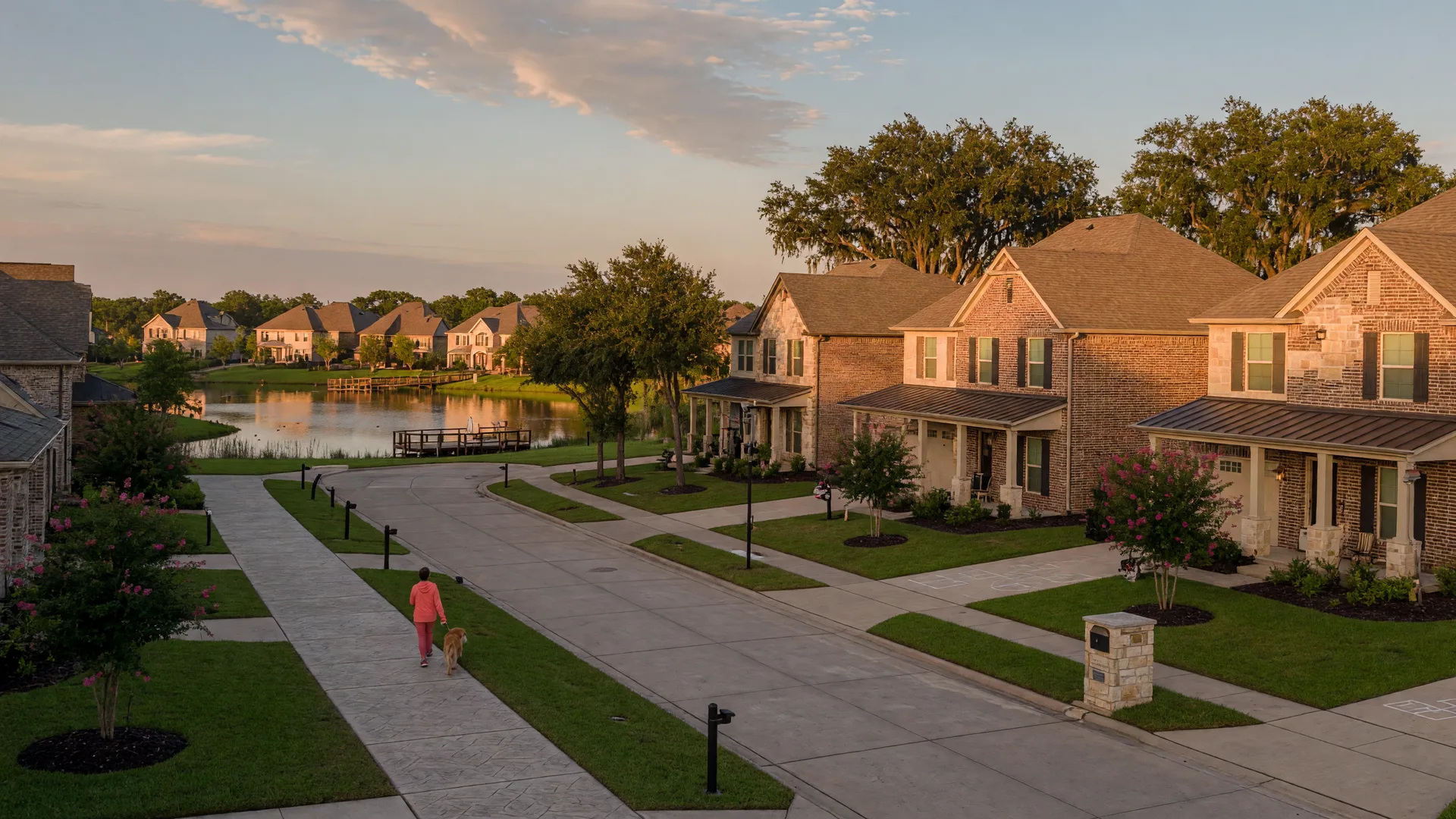
Illustrative image.
Katy is one of the fastest-growing places west of Houston, and the reason is simple: strong schools, resort-style master-planned communities, more house for the money than closer-in Houston, and a commute to the Energy Corridor that beats living downtown. But newcomers make one mistake more than any other: they assume a Katy mailing address means they live in the City of Katy, or that every Katy address feeds Katy ISD. Both assumptions are wrong. This guide lays out what to actually know before you relocate, with every figure sourced and dated for 2026.
The geography newcomers get wrong: City of Katy vs. greater Katy vs. Katy ISD
"Katy" is three different things, and the difference matters for taxes, schools and what your weekend looks like.
- The City of Katy is a small incorporated town where Harris, Fort Bend and Waller counties meet, incorporated in 1945 and covering roughly 15.3 square miles. The U.S. Census Bureau's July 1, 2025 estimate puts its population at about 28,373, up from roughly 21,900 at the 2020 census. This is the historic core: Old Town, the railroad district, and the festivals on Historic Town Square.
- Greater Katy is the much larger suburban region that shares the Katy mailing address, spreading across the same three counties with no single municipal government. The Katy Area Economic Development Council puts the greater Katy population at roughly 340,000, and recent Census data (ACS 2024) counts about 463,000 people living within Katy ISD boundaries. Most of the big master-planned communities sit here, not inside the city limits.
- Katy ISD is the school district, and its boundaries roughly track greater Katy but are not identical. Some addresses with a Katy mailing address are zoned to Lamar ISD or Royal ISD, and some Katy ISD territory lies outside the City of Katy entirely.
The school zoning guide explains how to verify any specific address, and the community map labels every community by its true geography so you are never comparing apples to oranges.
Why families actually move to Katy
The top draw is Katy ISD, which serves roughly 95,000 to 96,000 students across about 78 to 81 campuses, including 49 elementary schools, 18 middle schools and 11 high schools. The district earned a B rating (score of 88) from the Texas Education Agency for 2024-25, its third consecutive B, and it is consistently ranked among the strongest districts in the Houston area. The second draw is the master-planned communities themselves: Cinco Ranch, Grand Lakes, Cross Creek Ranch, Cane Island and others build in lakes, pools, trails and parks as part of the neighborhood, not as an afterthought. The community comparison post lines up the biggest plans side by side.
The cost of living: modestly below the national average
Katy is generally a little less expensive than the United States as a whole, though the exact figure depends on the source. PayScale puts it about 11 percent below the national average, Salary.com about 6 percent, ERI about 5 percent, and BestPlaces gives a cost-of-living score of 96.9, or about 3 percent below average. Housing is the biggest factor: PayScale lists housing in Katy at roughly 29 percent below the national average. A fair summary for 2026 is that Katy runs about 3 to 11 percent below the national average depending on the index, with the savings concentrated in housing. For current list prices and sale trends, the market update keeps the dated, sourced numbers.
The commute to Houston
Katy sits roughly 25 to 30 miles west of downtown Houston, mostly along I-10, the Katy Freeway, which widens to 26 lanes between Beltway 8 and SH 99. Typical drive times depend on your exact ZIP and the hour, but the planning numbers are roughly: the Energy Corridor about 13 miles (17 to 22 minutes off-peak), downtown Houston about 30 miles (32 to 42 minutes off-peak), and the Texas Medical Center about 28 miles (35 to 46 minutes). Peak-hour eastbound runs can stretch to 60 to 90 minutes, and the return trip in the evening similar. The commute guide breaks down I-10's managed lanes, the Grand Parkway (SH 99), the Westpark Tollway and the trade-offs residents actually budget for.
Where newcomers actually settle
Most relocating families land in one of the master-planned communities, and each has a distinct feel. Cinco Ranch is the established giant with mature trees and a settled school zone. Grand Lakes pairs lakes and a lazy river with a tight-knit feel. Cross Creek Ranch and the newer plans like Elyson and Sunterra trade that maturity for brand-new homes and amenities still being built out. If you prefer a walkable small-town core, Old Town Katy and the surrounding historic blocks offer something the master plans do not. Browse the community guides and the comparison post to match a neighborhood to your lifestyle before you start touring houses.
Lifestyle: what weekends actually look like
Beyond the schools and the commute, Katy lives well: county and city parks, community pools and water parks, a brewery row in the old rail district, an outlet mall and open-air shopping at LaCenterra, and a festival calendar that peaks with the Katy Rice Harvest Festival each October and the Old-Fashioned Christmas Festival in December. The lifestyle guide lists real, verified places with their own websites, and the events page keeps the current, dated calendar.
A relocation checklist for your first weeks
- Verify the school zone by exact address. A Katy mailing address does not guarantee Katy ISD. Use the district's boundary lookup, not the community's brochure.
- Know which "Katy" you are buying into. City limits, greater Katy and Katy ISD have different taxes, services and school footprints.
- Price the full monthly cost. HOA dues and MUD taxes vary widely by community and can outweigh a lower purchase price.
- Test the commute at the hour you will drive it. Off-peak times flatter the trip; drive it at 7 a.m. before you commit.
- Match the community to your stage of life. A brand-new plan is not the same as a mature one, even at the same price.
Ask Carol: relocating to Katy, done right
A relocation is a sequence of decisions, and having a local agent who knows the geography can save you weeks. Carol Jukes, Broker/Owner of Realty Pros of Texas, has spent decades helping families move into Katy and the Greater Houston area, and she can pull current listings, tax statements and school-zone confirmations for the specific communities you are considering. Call (832) 212-2772 or send a note through the contact page to start the conversation. If you are still early in the process, the first-home checklist and the buying guide map out the full path from pre-approval to closing.

Carol Jukes
Broker/Owner of Realty Pros of Texas with 40+ years in Houston real estate and 1,500+ homes sold. Ask her anything about buying, selling or living in Katy and the Greater Houston area.
Ask Carol a question