Old Town Katy: how a railroad crossing became Texas' favorite small town
Illustrative image.
Katy did not start as a suburb. It started as a prairie settlement called Cane Island, named for Cane Island Creek, and it became a town only because a railroad needed a right of way. That railroad, the Missouri-Kansas-Texas line, is the whole reason this west Houston region carries the affectionate name “Katy.” Here is the story, and why the old town core still matters to anyone buying here today.
The railroad that named a town
In April 1893 the MKT began laying track through the area and completed the line in 1895, the first railroad to enter Texas from the north. Texans shortened the railroad's initials to “the Katy,” and when James Oliver Thomas laid out the town site in 1895 and secured a post office in January 1896, the town took the railroad's nickname for its own. The first station was famously modest: a boxcar and a water tank, with a proper depot finished around 1898.
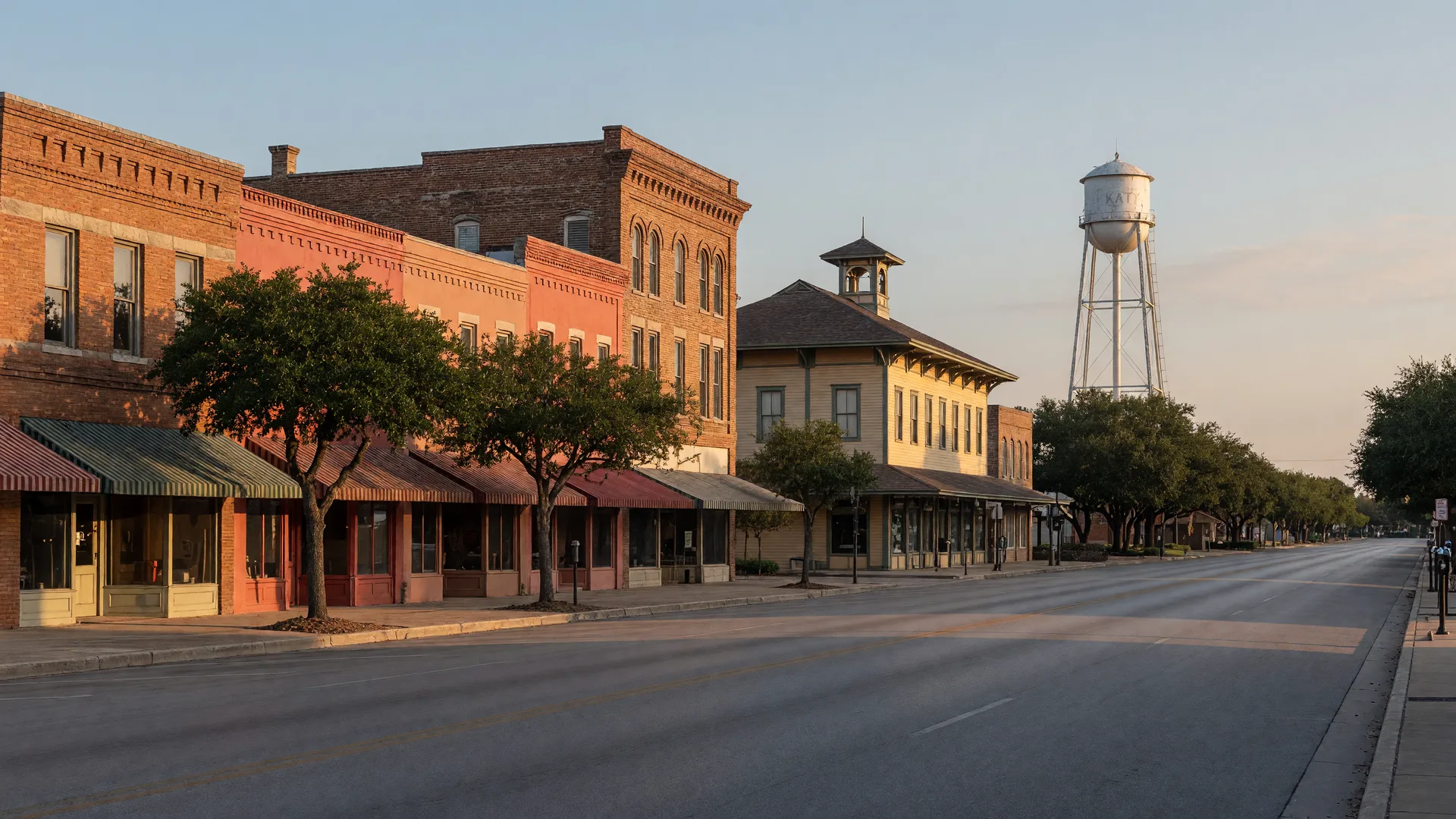
Old Town Katy is that original townsite, laid out along the rail corridor that runs parallel to today's I-10 and U.S. 90. The restored 1890s to 1920s storefronts you see today along Avenue A, Second Street and the surrounding blocks are the physical record of the town's first quarter century.
A small city, incorporated in 1945
The City of Katy was formally incorporated in 1945, with C. L. Baird as its first mayor, and it has stayed small in a region that grew enormous around it. The U.S. Census Bureau estimated the city's population at roughly 28,000 in 2025. Nearly all of the growth residents experience as “Katy” happened outside the city limits, in unincorporated Fort Bend and Harris County master-planned communities that carry Katy mailing addresses.
That distinction matters for buyers: Old Town is genuinely inside the City of Katy, with city services and Katy police, while Cinco Ranch, Grand Lakes and most other communities are not. The geography is explained plainly on the communities hub and in the FAQ.
What the old core is today
Old Town has become the region's gathering place. No Label Brewing operates out of the old railway buildings on First Street, coffeehouses like Humble Grounds and Serene Beans line the blocks, and monthly Katy Market Days fill Second Street with vendors. Twice a year the whole region shows up: the Katy Rice Harvest Festival in October and the Old-Fashioned Christmas Festival in early December, both staged around Historic Town Square at 904 Avenue C.
“The water tower still reads KATY on the way in, just like it did when the depot was the whole town.”
Walking Old Town is the fastest way to understand Katy's identity: a real small town that happens to sit at the center of one of America's fastest-growing suburban regions. Living in the old core is a different proposition from living in a master plan, and it is worth seeing both before you choose.

Carol Jukes
Broker and CEO of Realty Pros of Texas with 40+ years in Houston real estate and 500+ homes sold. Ask her anything about buying, selling or living in Katy and the Greater Houston area.